
I remember the day I first truly considered a "blended learning course." The phrase itself sounded a bit like something from a futuristic movie, a mash-up of concepts I thought were mutually exclusive: learning online and learning in a traditional classroom. I’d always pictured education as one or the other – either you sat in a lecture hall, scribbling notes, or you stared at a screen, clicking through modules alone. But life, as it often does, threw a curveball, and suddenly, this "blended" idea started looking less like science fiction and more like my only viable path forward.
You see, I had a demanding job, a growing family, and a persistent itch to learn something new, something that would push my career in a fresh direction. The idea of committing to a fixed schedule of evening classes felt like trying to fit a square peg into an already overflowing round hole. And while purely online courses offered flexibility, I worried about the lack of real human connection, the kind of spontaneous discussion that truly sparks understanding. I thrive on interaction, on seeing the light bulb go off in someone else’s eyes, or feeling the energy of a shared discovery. So, when a program I was eyeing mentioned its blended format, I was intrigued, if a little skeptical.
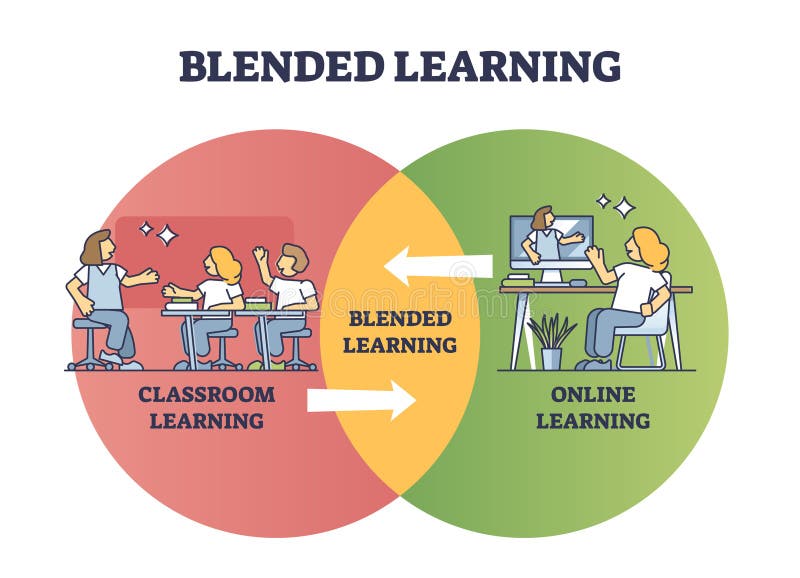
The course description promised the best of both worlds: the convenience of digital resources and self-paced study combined with the richness of face-to-face interaction. It sounded almost too good to be true. Was it truly possible to get the depth of a traditional classroom experience without sacrificing the flexibility I desperately needed? I decided to take the leap.
My journey began, as many modern adventures do, with an email. It was a welcome message to the online portal, a digital hub that would become my second home for the next few months. Logging in for the first time felt like stepping into a new, organized universe. There were modules neatly laid out, each containing readings, video lectures, discussion prompts, and assignments. This was the "online" part of the blend, the asynchronous component that I could tackle whenever my schedule allowed – late at night after the kids were asleep, early mornings before work, or even during a quiet lunch break.
I quickly discovered the magic of this self-paced learning. Instead of rushing to jot down every word during a live lecture, I could pause a video, rewind a confusing section, and re-read a complex article until it truly sank in. This wasn’t just about speed; it was about depth. I could spend extra time on topics that challenged me and skim through those I already grasped. The discussion forums, initially intimidating, soon became a vibrant space. Our instructor would post thought-provoking questions, and we, the students, would chime in with our perspectives, sharing insights from our varied backgrounds. It was fascinating to see how a single concept could be interpreted so differently, leading to a much richer understanding than I might have gained simply listening to a single voice. These digital conversations built a foundation, preparing us for the deeper dives we’d eventually have in person.
But let’s be honest, it wasn’t always a smooth sail. There were moments of genuine struggle. The biggest hurdle, I found, was self-discipline. With no fixed class time forcing me to be present, it was easy to procrastinate. The lure of "just one more episode" or "I’ll do it tomorrow" was strong. I learned, very quickly, that success in blended learning demanded an almost military-level commitment to scheduling. I started blocking out specific times in my calendar, treating my online study sessions like non-negotiable appointments. I found a quiet corner in my house, free from distractions, and made it my dedicated learning zone. Sometimes, I’d even pack up my laptop and head to a coffee shop, the low hum of conversation surprisingly helpful in keeping me focused.
Then came the "in-person" component, the part I was both most excited and most nervous about. Our first face-to-face session was scheduled a few weeks into the course. Walking into that classroom felt different from any class I’d attended before. There was an immediate sense of familiarity, even though most of us were meeting for the first time. We had already "met" online, exchanged ideas in forums, and watched each other’s introductory videos. It was like finally putting faces to the names I’d seen on my screen.
The classroom sessions weren’t about lectures, at least not in the traditional sense. We weren’t there to passively receive information. Instead, these were highly interactive workshops, problem-solving sessions, and collaborative projects. Our instructor, who had been guiding our online discussions, was now a facilitator, steering our conversations, posing challenging questions, and encouraging us to build on each other’s ideas. This is where the true "blending" happened. The theoretical knowledge we had absorbed online came alive. We applied concepts, debated different approaches, and worked in small groups to solve real-world case studies.
I remember one particular session where we were grappling with a complex analytical tool. Online, I had watched videos and read step-by-step guides, understanding the mechanics theoretically. But in the classroom, when we had to actually use the software on a shared dataset, I encountered roadblocks I hadn’t anticipated. It was in that moment, seeing my peers struggle with similar issues, and then watching our instructor patiently guide us through the nuances, that the concept truly clicked. The immediate feedback, the ability to ask a question and get a live demonstration, the collective problem-solving – these were invaluable. This human element, the shared struggle and triumph, cemented the learning in a way no solo online session ever could.
The in-person sessions also fostered a sense of community that I had worried would be absent in a blended format. During breaks, we’d chat about our jobs, our lives, and the challenges we faced. We formed study groups that continued our discussions online, using video calls to clarify concepts or prepare for assignments. This peer support network became incredibly important, turning a potentially isolating experience into a truly collaborative one. We were no longer just individuals learning; we were a collective, pushing each other forward.
One of the most profound aspects of blended learning, for me, was how it catered to different learning styles. For those who thrived on independent study and reflection, the online modules offered ample space. For those who learned best through discussion and hands-on application, the in-person sessions were a goldmine. I found myself appreciating both equally, realizing that my own learning style wasn’t a fixed entity but rather a spectrum that benefited from varied approaches. Sometimes I needed the quiet introspection of reading an article alone, and other times I needed the dynamic energy of a group brainstorming session. Blended learning provided both.
This approach also forced me to develop new skills that extended beyond the subject matter itself. My time management improved dramatically. Juggling work, family, and studies required meticulous planning and discipline. My digital literacy soared; I became proficient with various online tools, collaboration platforms, and research databases. My communication skills, both written (through forum posts and essays) and verbal (during in-person discussions and presentations), became sharper. Most importantly, I cultivated a stronger sense of self-motivation and responsibility for my own learning journey. There was no one constantly looking over my shoulder; the onus was on me to engage, to inquire, and to deliver.
Looking back, the entire experience was a testament to the power of thoughtful design in education. It wasn’t just about tacking online modules onto a traditional course. It was about strategically deciding which elements were best delivered online and which truly benefited from face-to-face interaction. The online component handled the foundational knowledge transfer, allowing us to arrive at the in-person sessions prepared to engage at a higher level – not just to absorb, but to analyze, synthesize, and create.
For anyone considering a blended learning course, I would offer a few pieces of advice, born from my own experience. First, embrace the technology. Don’t be afraid to explore the online platform, participate actively in discussions, and experiment with digital tools. Second, be proactive about your schedule. Treat your study time with the same respect you give to work meetings. Third, engage with your peers. Form study groups, ask questions, and offer help. The community aspect can be one of the most rewarding parts. Finally, communicate with your instructors. If you’re struggling, reach out. They are there to guide you through both the online and in-person aspects.
The world of education is changing, and blended learning courses are at the forefront of this evolution. They offer an incredible opportunity for individuals like me – people with complex lives, diverse commitments, and a burning desire to continue learning. They break down geographical barriers, offer unprecedented flexibility, and, when done well, create a learning experience that is richer and more engaging than either purely online or purely traditional formats can offer alone.
My personal adventure into blended learning wasn’t just about gaining a new qualification; it was about discovering a new way to learn, to grow, and to connect. It transformed my understanding of what education could be, proving that the future of learning isn’t about choosing between digital and physical, but about intelligently weaving them together to create something truly powerful. If you’re standing at a similar crossroads, wondering if this "blend" is right for you, I wholeheartedly encourage you to take the leap. You might just find, as I did, that it opens up a world of possibilities you never imagined.