
I remember standing at a crossroads, feeling a familiar ache of stagnation. My days were a blur of tasks that didn’t quite click, a career path that felt more like a winding alley than a grand avenue. I wasn’t creating, not truly. I was just… doing. This was a few years back, before I stumbled upon something that would not only redefine my professional life but also reshape the way I looked at the world: User Experience, or UX. And more specifically, the transformative power of a well-chosen UX course.
It started subtly, a whisper on the wind, a term I kept seeing pop up in articles about tech, design, and even business strategy. "User Experience." At first, it sounded like corporate jargon, another buzzword to add to the pile. But the more I dug, the more I realized it was something profound. It was about making things work better for people, anticipating their needs, solving their frustrations before they even voiced them. It was about empathy, problem-solving, and creation, all rolled into one. This clicked with a part of me I hadn’t realized was yearning for expression – the part that loved puzzles, understood human quirks, and secretly rearranged supermarket shelves in my head to make them more logical.
The idea of pivoting my career felt daunting. I wasn’t a designer, nor a coder. My background was in something entirely different, something that involved more spreadsheets and less human-centered thinking. But the more I researched, the more I saw that UX wasn’t just for a specific type of person. It was for anyone who wanted to build meaningful things, anyone who cared about the people interacting with their products, digital or otherwise. And that’s when the idea of a UX course began to solidify in my mind. It felt like the map I needed to navigate this exciting new territory.
The sheer volume of UX courses out there was overwhelming. Bootcamps promising a new career in a few months, online platforms offering self-paced learning, university programs stretching over years. My head spun with options. How do you choose when each one claims to be the best, the most comprehensive, the fastest track to success? I spent weeks poring over syllabi, reading reviews, watching introductory videos. I needed something that would give me a solid foundation, practical skills I could immediately apply, and a sense of direction. Crucially, I also needed something that understood I was a complete beginner. I wasn’t looking for a magic bullet, but a structured path to understanding this intricate field.
Eventually, I settled on an intensive online UX course that blended live sessions with self-study modules and project-based learning. It wasn’t cheap, but it felt like an investment in myself, a leap of faith into a future I was starting to envision. The first few weeks were a whirlwind. We started with the absolute basics, peeling back the layers of what "user experience" truly meant. It wasn’t just about pretty interfaces; it was about understanding the human at the other end of the screen. Our instructors, seasoned professionals with years in the field, shared war stories and real-world examples that brought the concepts to life.
We dove headfirst into user research. This was eye-opening. Before the course, I thought "research" meant looking things up online. But here, we learned about empathy interviews, contextual inquiries, surveys, and usability testing. We were taught how to ask the right questions, not just what people wanted, but why they wanted it. We learned to listen actively, to observe body language, to uncover unspoken needs and frustrations. I remember one early assignment where we had to interview three people about their morning routine. Simple, right? But the insights I gained about their pain points – the cluttered bathroom counter, the confusing coffee machine, the struggle to find matching socks – were profound. It taught me that even the most mundane activities are ripe for improvement through thoughtful design. This module solidified for me that UX wasn’t just about technology; it was about humanity.
Next, we moved into the realm of defining the problem and ideating solutions. This is where the creativity really sparked. We learned about creating personas – fictional representations of our target users, complete with their goals, frustrations, and motivations. Crafting a persona for "Busy Brenda, the working mom who needs to organize her digital photos" felt like bringing a character to life. Then came user flows and journey maps, visualizing the steps a user takes to accomplish a task. This was like drawing a treasure map, each step a carefully considered part of the journey. The course introduced us to various brainstorming techniques – crazy eights, mind mapping – encouraging us to think outside the box, to embrace even the wildest ideas before refining them. This part of the course felt like being given a license to play, to imagine a better world one interaction at a time.
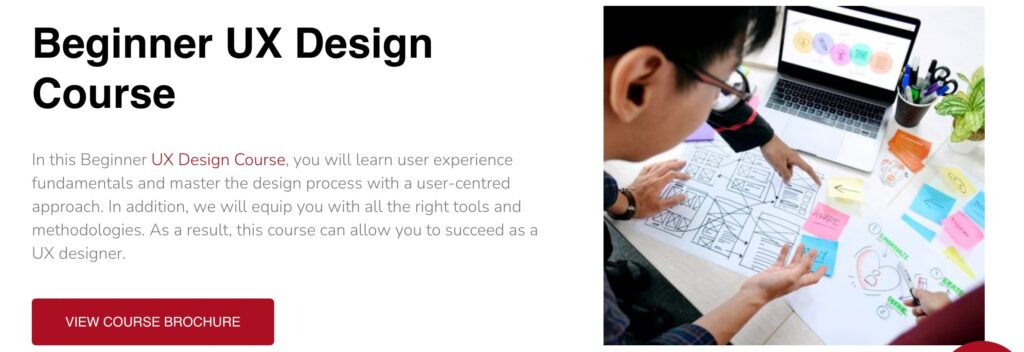
Then came the tools, and my initial apprehension. I’d never used design software before. Figma, Sketch, Adobe XD – they all sounded alien. But the course broke it down, step by step. We started with low-fidelity wireframes, essentially rough sketches of screens, focusing purely on layout and functionality, not aesthetics. It was like building with LEGOs, focusing on the structure before painting the walls. Then, gradually, we moved to higher-fidelity prototypes, adding more detail, color, and interaction. I remember the thrill of seeing my first interactive prototype come to life, clicking through screens I had designed, feeling like I was truly building something tangible. It wasn’t about being an artist; it was about clearly communicating ideas and making them testable. The instructors emphasized that the tools were just that – tools. The real skill was in the thinking behind the design.
The most critical phase, for me, was usability testing. It’s one thing to design something you think is great; it’s another entirely to watch real people try to use it. This was humbling and incredibly illuminating. I learned that my carefully crafted designs often had glaring flaws I hadn’t even considered. Users would click in unexpected places, misunderstand labels, or struggle with what I thought was an intuitive flow. The course taught us how to conduct usability tests, how to observe without leading, how to gather unbiased feedback, and most importantly, how to iterate. This wasn’t about ego; it was about improving the user’s experience. We learned to embrace feedback, to see it not as criticism, but as valuable data points guiding us toward a better solution. The iterative nature of UX – research, design, test, refine, repeat – became deeply ingrained. It was a continuous cycle of learning and improvement.
Beyond the specific skills and tools, the UX course fostered a profound shift in my mindset. I began to see the world through a new lens. Every app, every website, every physical product I encountered, I started analyzing its user experience. Why was this door handle so hard to turn? Why did this ATM menu confuse me? What were the designers trying to achieve, and where did they succeed or fail from the user’s perspective? This constant observation turned everyday frustrations into opportunities for learning and problem-solving. It was like gaining a superpower, an ability to deconstruct and reconstruct the world around me with a user-centric focus.
The course also emphasized the collaborative nature of UX. We worked in teams on several projects, simulating real-world scenarios. This taught me invaluable lessons about communication, compromise, and leveraging diverse perspectives. We had to present our work, defend our design decisions with research, and articulate our thought process clearly. These presentation skills, initially terrifying, became a vital part of my toolkit. I learned that a brilliant design is only as good as its ability to be understood and advocated for.
As the course neared its end, the focus shifted to career preparation. This was a crucial bridge from learning to doing. We dedicated significant time to building a portfolio – curating our best projects, articulating our design process, and showcasing our problem-solving abilities. The instructors provided personalized feedback on our portfolios, helping us craft compelling narratives around our work. We also covered interview techniques, how to talk about UX, and how to effectively network within the industry. It felt like the course wasn’t just teaching me skills, but actively equipping me for the journey ahead.
So, who is a UX course for? I’d say it’s for anyone feeling that same itch I did – the desire to create, to solve real problems, to make a tangible impact on how people interact with technology and the world around them. It’s for the empathetic person who enjoys understanding others, the curious mind who loves puzzles, the methodical thinker who appreciates structure, and the creative spirit who wants to bring ideas to life. You don’t need a design background or a computer science degree. What you need is an open mind, a willingness to learn, and a genuine interest in people.
If you’re considering taking the plunge, here’s some advice I gathered from my own experience and from watching my peers:
First, research the curriculum thoroughly. Look beyond catchy marketing phrases. Does it cover the fundamentals: user research, information architecture, wireframing, prototyping, usability testing? Are there modules on popular design tools? What kind of projects will you work on? A strong curriculum will provide a balanced mix of theory and hands-on application.
Second, consider the instructors. Are they industry professionals with real-world experience? Can they share practical insights and not just textbook knowledge? Look for testimonials that speak to their teaching style and mentorship.
Third, evaluate the course format. Online, in-person, self-paced, bootcamp – each has its pros and cons. An intensive bootcamp might accelerate your learning but demand a significant time commitment. A self-paced online course offers flexibility but requires strong self-discipline. Think about your learning style and current life circumstances. For me, the blend of live sessions and self-study was perfect, offering structure without being overly rigid.
Fourth, pay attention to portfolio building and career support. This is often the differentiator. A good UX course won’t just teach you skills; it will help you package them into a compelling portfolio and guide you through the job search process. Look for courses that include portfolio reviews, interview prep, and potentially alumni networking opportunities.
Fifth, read reviews and talk to alumni. There’s no better insight than hearing from people who have actually gone through the program. Ask about their experiences, their successes, and any challenges they faced. This can give you a realistic picture of what to expect.
Finally, don’t be afraid to start small. If a full-blown course feels too big a leap, try a shorter introductory workshop or a free online resource to dip your toes in. The key is to start learning, to get a feel for the field, and to see if it truly resonates with you.
Life after the course has been everything I hoped for and more. That investment in a UX course was one of the best decisions I’ve ever made. My first UX role wasn’t glamorous, but it was real. I was part of a team, contributing to products that real people used. I found myself applying the principles I learned every single day – conducting mini-interviews, sketching out user flows, testing small changes, advocating for the user. The initial imposter syndrome gradually faded as my skills grew and my confidence blossomed.
The world of UX is constantly evolving, which means the learning never truly stops. New tools emerge, new methodologies gain traction, and user behaviors shift. But the foundational principles taught in a good UX course – empathy, problem-solving, iteration – remain timeless. They are the bedrock upon which you can build a fulfilling and impactful career.
If you’re feeling that familiar ache of stagnation, that desire for a career that feels meaningful and dynamic, I wholeheartedly encourage you to explore the world of UX. A well-structured UX course can be the catalyst, the guide, and the community you need to embark on an incredibly rewarding journey. It was for me, and I’m confident it can be for you too. Take that leap of faith. The world is waiting for your thoughtful designs.